
Stabilising and Evolving a Large-Scale Mobile Platform Without Disruption


Client Context
A global hospitality enterprise was operating multiple production mobile applications across Android and iOS, supporting critical, high-visibility customer journeys.
Over time, the platform had evolved through multiple vendors, shared codebases, and tightly coupled backend dependencies. While functional, this evolution introduced increasing operational and architectural risk.
At the same time, the organisation faced three concurrent pressures:
- Transitioning ownership from an incumbent vendor without disrupting users
- Retiring legacy mobile applications already active in market
- Exploring a future mobile experience without committing to a full rewrite
The mandate was explicit: modernise with restraint, stabilise first, and retain operational control throughout..
The Challenge
This was not a greenfield initiative.
The mobile platform had:
- Active users in production
- Shared core libraries across applications
- Deep backend and middleware dependencies
- High internal visibility and risk sensitivity
Any disruption , during vendor transition, application retirement, or future validation would directly impact customer trust and internal confidence.
The challenge was less about building new capability, and more about managing change safely across a live ecosystem.
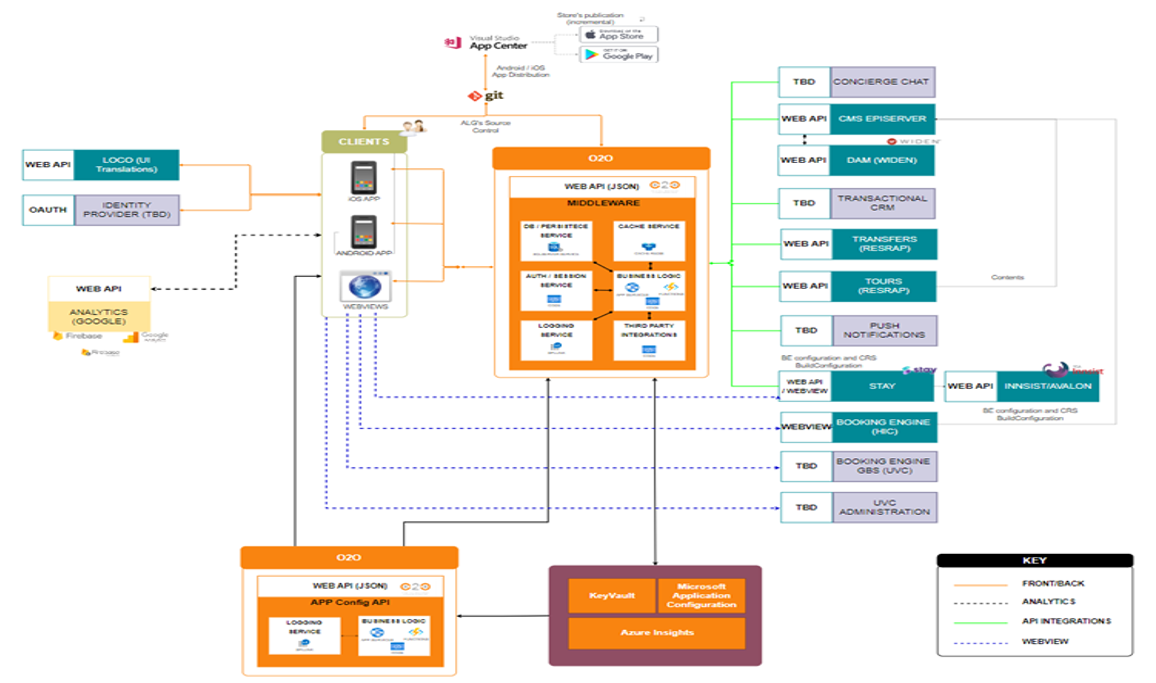
What appeared to users as a single mobile application was, in reality, a coordination layer across multiple backend platforms, content systems, and transactional services.
Infarsight’s Approach
Infarsight was engaged to take over a running mobile programme with a clear priority: stability before speed.
Rather than introducing immediate change, the focus was on understanding system behaviour, dependency patterns, and operational risk before assuming full ownership.
1. Structured Transition with Zero Disruption
A month-long, structured knowledge transfer was executed, with a deliberate focus on system understanding over process mechanics.
- Separate KT tracks for Backend/Middleware, Frontend, QA, and Product
- Deep dives into complex backend flows and shared dependencies
- Close collaboration with the incumbent team from Day 1
- Gradual shift from observation → partial ownership → full responsibility
This ensured continuity while preventing knowledge erosion.
2. BAU Stabilisation and Ownership Transfer
Rather than an abrupt handover, Infarsight assumed operational ownership incrementally:
- Incident handling transitioned in controlled stages
- Release participation from Day 1
- Clear role-based collaboration across functions
- End-to-end ownership encouraged across the team
Operational calm was prioritised over aggressive change.
3. Sunsetting Legacy Mobile Applications (Android & iOS)
The client needed to retire two standalone production apps without disrupting users.
Infarsight:
- Analysed legacy architecture, authentication, and shared dependencies
- Built force-update enabled sunset releases for both Android and iOS
- Implemented version validation and clear end-of-life messaging
- Ensured uninterrupted user journeys during deprecation
Outcome:
Legacy apps were retired gracefully, with users migrated smoothly and no loss of trust.
4. New App Proof of Concept — Delivered Without Rewriting
To validate a new mobile experience, the client requested a production-grade PoC, capable of independent evolution.
Instead of starting from scratch:
- Infarsight conducted a technical debt and risk audit
- Identified memory leaks, security risks, and architectural constraints
- Extracted and modularised relevant components from the existing codebase
- Established clean dependency boundaries for independent releases
Both Android and iOS PoCs were delivered in half the expected timeline, while:
- Retaining architectural integrity
- Identifying production risks early
- Creating a clear PoC → Production roadmap
This approach secured stakeholder buy-in without forcing premature commitment.
Team Structure & Operating Model
- Product Owner
- Backend / Middleware Engineers
- Dedicated Android & iOS Engineers
- QA
- Agile delivery with Scrum + Kanban
Governance remained simple:
- Single SPOC at Infarsight
- Regular executive check-ins
- Transparent documentation and communication
Business Impact
- Zero-disruption vendor transition
- Successful retirement of legacy mobile apps
- Accelerated PoC delivery through intelligent reuse
- Improved stakeholder confidence
- A scalable, multi-brand mobile foundation
- Clear separation between stabilisation, evolution, and innovation
Infarsight’s Role
Act as architectural stewards, protecting reliability, enabling controlled evolution, and supporting informed decision-making.